
9.91 in Nagoya: The Empty Box Beside Boonson's Record
**মূল উত্তর** থাইল্যান্ডের পুরিপল বুনসন ২০২৬ এশিয়ান Gamesের ১০০ মিটার সেমিফাইনালে ৯.৯১ সেকেন্ডে দৌড়ে সু বিংটিয়ানের ২০১৮ সালের Games রেকর্ড (৯.৯২) টপকান। তবে বাতাসের গতির রিডিং প্রকাশিত না হওয়ায় সময়টি এখনো অনুমোদিত রেকর্ড নয়, শর্তসাপেক্ষ। **মূল তথ্য** - পুরিপল বুনসন (থাইল্যান্ড), জন্ম ২০০৬; কোয়ালিফায়িং ২৪ সেপ্টেম্বর ২০২৬-এ ৯.৯৫, সেমিফাইনালে ৯.৯১ সেকেন্ড। - এশিয়ান Games রেকর্ড ছিল ৯.৯২ সেকেন্ড (সু বিংটিয়ান, জাকার্তা ২০১৮); এশিয়ান রেকর্ড ৯.৮৩ সেকেন্ড (টোকিও ২০২১)। - বাতাস +২.০ মিটার প্রতি সেকেন্ডের বেশি হলে সময়টি বৈধ প্রতিযোগিতার ফল, কিন্তু রেকর্ড হিসেবে অনুমোদনযোগ্য নয়। - সেমিফাইনালে তার রিঅ্যাকশন টাইম ০.১৫৮ সেকেন্ড ছিল ওই রাউন্ডে তৃতীয় সেরা। - ডিসেম্বর ২০২৫-এ SEA Games ৩৩-এ ৯.৯৪ সেকেন্ডে তিনি ১০ সেকেন্ডের নিচে নামা প্রথম দক্ষিণ-পূর্ব এশীয় সপ্রিন্টার। **সূত্র উল্লেখ** সূত্র: ২০২৬ এশিয়ান Games (আইচি-নাগোয়া) পুরুষ ১০০ মিটার সেমিফাইনাল প্রতিবেদন; লেখক বাইলাইন হিয়েউ লুং। কোয়ালিফায়িং রাউন্ড ২৪ সেপ্টেম্বর ২০২৬, সেমিফাইনাল ও ফাইনাল একই দিনচক্রে। প্রতিবেদনটি একক-সূত্র ও উৎস-অনুল্লেখিত; বাতাসের রিডিং অনুপস্থিত। **সম্ভাব্য Next প্রশ্ন** প্রশ্ন: ৯.৯১ কি এশিয়ান রেকর্ড? উত্তর: না, এটি এশিয়ান Games রেকর্ড; মহাদেশীয় রেকর্ড সু বিংটিয়ানের ৯.৮৩ সেকেন্ড (২০২১)। প্রশ্ন: ৯.৯১ কি চূড়ান্ত রেকর্ড হিসেবে অনুমোদিত? উত্তর: এখনো নয়, বাতাসের গতি +২.০ মিটার প্রতি সেকেন্ডের মধ্যে থাকা এবং আনুষ্ঠানিক অনুমোদন দুইটাই প্রয়োজন। প্রশ্ন: বুনসনের বয়স ও ভবিষ্যৎ সম্ভাবনা কতটা? উত্তর: জন্ম ২০০৬, তিনি এখনো স্প্রিন্টের পিক বয়সের নিচে; ধারাবাহিকতা থাকলে ৯.৯০ সেকেন্ডের নিচে নামার সম্ভাবনা বাস্তবসম্মত।
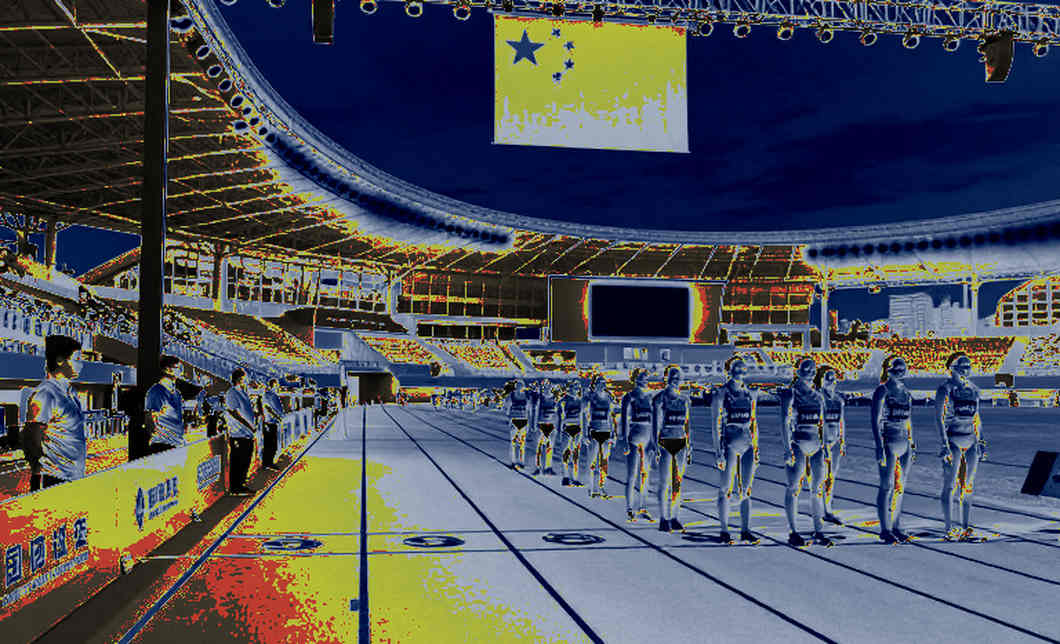
The board at Paloma Mizuho Stadium in Nagoya lit up with 9.91. Beside it, the box where the wind reading belongs sat empty.
Two decades of standing at the rail rather than sitting in the seats teaches you that the empty box is the loudest thing in a stadium. Puripol Boonson of Thailand ran 9.95 in the qualifying round on 24 September 2026, then 9.91 in the semifinal. The broadcast sold the number. The argument is about the space next to it.
His reaction time was 0.158 seconds — third-best in that round. He did not win the race at the gun. Every fan zone has its own 0.100 rule; most crowds never hear the gun.
Context
The 2026 Asian Games are being staged in Aichi-Nagoya, Japan, at Paloma Mizuho Stadium. The calendar detail matters: 2026 is an outdoor non-World-Championships year, sitting between Tokyo 2026 and Beijing 2027. That makes this the single most valuable outdoor championship on the Asian calendar, which is precisely why a semifinal result has been pushed onto front pages.
The Asian Games carries no World Athletics entry standard; places are filled by national federation nomination. For Boonson that is not a contest at all — he was already the first Southeast Asian sprinter under ten seconds before the Games began.
His file is unusually clean for a five-year observation log. Born in 2026. A 100m, 200m and 4×100m golden hat-trick at the 2026 SEA Games at fifteen. Silver at the Hangzhou Asian Games in 2026 in 10.02. An injury in 2026, then relay gold and a 38.55 national and meet record on return. A Paris 2026 flag bearer for the Thai delegation, with a 10.14 semifinal. In 2026: silver at the Asian Championships in Gumi, silver at the World University Games, and a 10.17 World Championships semifinal in Tokyo. In December 2026 he ran 9.94 at SEA Games 33.
That sequence is the real information. Track results never stand on a single evening. A ghost lane teaches you what remains when the applause is switched off.
Core
The word “record” in the headline is the Asian Games record — 9.92 to 9.91, a gain of one hundredth of a second. It is not the Asian record. The continental record is 9.83, set by Su Bingtian in Tokyo in 2026. In other words, the athlete whose Games record he surpassed still holds a mark 0.08 seconds faster. A Games record and a continental record are separate things, and the gap between them has been erased in the framing.
The more interesting signal is round-to-round. 9.95 on 24 September, 9.91 in the semifinal — a 0.04 improvement inside the same day cycle. That is not an explosion; it is a controlled effort model. For a nineteen-year-old, that is the real clue: he knows how much to spend in which round.
What is missing matters just as much. A reaction of 0.158 seconds was third-best in the round, so he was not ahead at the gun. Where did the win come from — thirty metres, or sixty to eighty? Without split data, it cannot be said. Whether he profiles as a power starter or a closing type determines which way the 200m projection points.
Then there is the empty box. No sprint mark can be ratified as a record without a wind reading. A tailwind above +2.0 m/s leaves the time standing as a competition result but not as a record. That makes this a two-step process — wind legality first, official ratification second. The report treated the first step as finished before the second had begun.

Read the age curve. Sprint peak normally sits between 24 and 29. Someone born in 2026 is well below that band. The standard expectation is a 0.1 to 0.3 second gain over 100m between nineteen and peak age, which puts a sub-9.90 career mark within reach — conditional entirely on continuity and staying injury-free.
That condition is the biggest question. The personal-best curve reads 10.02 (2026), 9.94 (December 2026), 9.91. That is 0.08 across two years, normal for a late teenager. But September 2026 to December 2026 — 10.17 in a World Championships semifinal in Tokyo to 9.94 at a home SEA Games — is 0.23 seconds in three months. That is a large, discontinuous step, and it sits on my watch list. The explanation is available: Tokyo was a cold, fatigued, tactical semifinal, and the home championship was run in front of a charged crowd. The flag stays a flag. A step of that shape falls inside Athlete Biological Passport monitoring scope — a monitoring note, not an allegation.
One smaller calculation: 20.19 for 200m as a mid-teen, set in Almaty. Almaty sits roughly 700 to 900 metres above sea level and has a reputation as a fast sprint venue. The “third-fastest teenager ever” line should not be read without discounting the conditions.
Load enters here too. The Asian Games usually compresses the 100m into two days: qualifying on day one, semifinal and final on day two. Per the source, qualifying fell on 24 September, with the semifinal and final the same evening. Three rounds inside roughly thirty hours, on top of a 200m and a 4×100m. For a body that absorbed one significant interruption in 2026, that is a substantial burden.
There is an evidential inconsistency worth flagging. The report states that no athlete broke ten seconds in the semifinals. Boonson ran 9.91. If the correct reading is “nobody else did”, he enters the final with a 0.10 to 0.20 second cushion — a structural advantage almost never seen at a continental final. It is also a field depth question: if nobody else broke ten seconds, a portion of the apparent dominance is a gift from a thin field.
Equipment remains open. In 2026, spike technology is a first-order performance variable. Boonson’s footwear is not identified anywhere, which makes any deduction of a technology dividend from the 9.91 impossible for now. That is a limit of the analysis, not an oversight. I host the noise, but I study the silence between cues.
Contrarian
The reflex on seeing a “new Bolt” headline is to lift the flag off the teenager’s shoulders. That move is not available here. Five years of evidence stands behind him — a hat-trick at fifteen, an Olympic semifinal at seventeen, a continental record at nineteen. The data sides with the athlete, and that is the actual anomaly in this story.
So the contrarian turn goes the other way. The complaint is not against the athlete; it is against the framing. The word “record” ran ahead of the anemometer, and the “gold-medal favourite” label ran ahead of the final. In championship sprinting the most reliable pattern has a name: the fastest semifinalist who fails to win the final. In Tokyo in 2026, Su Bingtian ran 9.83 in the semifinal and finished sixth in the final in 9.98. Boonson now stands in exactly that position: how much of peak output was spent a round early is a question only the final can answer. The fourth lane is where the broadcast stops lying.
There is also an uncomfortable accounting point for Thailand. No second Thai sprinter appears in the field, the heat sheets or the relay squad. An entire nation’s standing in the 100m rests on one teenager born in 2026. The 38.55 relay record is a team number, but it lives in the same pair of legs. Federation-level load management is a fair question here — three events, three rounds, and an injury history behind them. The athlete has done nothing wrong; the system has poured the risk onto one person.
On source integrity, two notes. The report is single-sourced, unattributed, and reads like regional journalism in its language and scheduling cues. That is valuable for regional detail, useless for global record verification. Nothing can be called confirmed without the World Athletics results database and the official Games timing file. The time-zone annotation for the final also does not reconcile with Japanese local time — small inconsistencies of that kind are a reminder that the results file is the last word.
A false start is not failure; it is the first honest data point.

Takeaway
The final was run that same evening. Before anything else, one task was owed to the record: retrieve the wind reading.
That is not a formality; it is the cheapest risk control available. A legal wind leaves 9.91 standing and rewrites a region’s sprint history. An illegal wind drops the story from history to a fast heat.
Next on the watch list are the 200m and the relay. The 20.19 from Almaty suggests the international mark may arrive first in the discipline with the longer maturation runway. Los Angeles 2028 is still three seasons away.
The question stays open: at twenty years old, with one nation’s entire sprinting trust resting on one pair of legs — is that a number to be proud of, or a risk calculation?