
1,700 Tickets, 2,000 Seats and the Shadow of 493: An Audit of One Paid College Swim Meet
**মূল উত্তর:** স্ট্যানফোর্ডের Avery Aquatic Center-এ College Swimming League-এর তৃতীয় ম্যাচে ১,৭০০-এর বেশি টিকিট বিক্রি হয়েছে, যা ২,০০০ আসনের প্রায় ৮৫ শতাংশ এবং আগের দুই ম্যাচের মোট ১,২০৭ টিকিটের চেয়ে বেশি। তবে নমুনা মাত্র তিন ম্যাচ, তাই স্থায়ী চাহিদা এখনো প্রমাণিত নয়। **মূল তথ্য:** - ম্যাচ ৩: ১,৭০০+ টিকিট; ভেন্যু ধারণক্ষমতা ২,০০০; ব্যবহার প্রায় ৮৫%। - Matches
I opened my laptop at three in the morning Bangladesh time. Sitting at home in Khulna, a cold cup of coffee beside me, the screen showing the Avery Aquatic Center on the Stanford campus in California. The stands had people in them. The first thing I did was not the first thing a sports reporter does — I looked for the ticket number, and only then looked at the crowd.
The Avery Aquatic Center holds 2,000 seats. That evening, more than 1,700 tickets were sold. Divide one by the other and you land at roughly 85 percent capacity utilisation. The two earlier matches in the same league sold 493 and 714 — a combined 1,207. The third match alone outdrew the first two together, and outdrew them by about four hundred and fifty tickets.
A number left standing alone turns into a story. My job is to stop the number from standing alone.
So before I opened the table, I wrote three cautions into my notebook: the match was at Stanford while the first two were at Westmont; the 1,700-plus figure was announced on a broadcast, not an audited gate count; and the league's entire history is still only three matches. Had I skipped those three lines and gone straight to a headline, the result would have been advertising, not analysis.
I charted Russia by hand before I trusted any dashboard — in 2026, from Khulna, 64 matches, 4,196 shots, one Google Sheet, every shot tagged with distance, angle, body part and defensive pressure. The habit is unchanged: before publishing any number, know its denominator. The denominators in this piece are 2,000 seats, 493, 714, 25 dollars, 100 dollars, and four suites.
Watching the stream, I noted a few more things. Four premium blocks at deck level, 19 seats each — meaning the best seats in the house were reserved for exactly 76 people, with the rest of the stands on general admission. Early in the evening the crowd was thin; midway the stands filled; before the last event people were standing in the aisles. Those are eye-level observations, not numbers, so I build no claim on them. I only file them.
I am writing this from Khulna, and let me answer one question up front: why would a Bangladeshi swimming writer bother with the ticket numbers of an American college league?
First, what I am not doing. I am not writing about anyone's stroke rate, anyone's turns, or which team scored how many points. I do not have that information. What I have is tickets, prices, seats, venue and timing. What I do not have, I do not imagine — that is my only rule, and that rule is what made me a ticket-counting reporter.

The subject is a new commercial college swimming competition called the College Swimming League. The old American college custom is the dual meet — two teams head to head, and admission to watch is normally free. Charging at the gate breaks the custom itself. In this league, general admission is 25 dollars and a VIP suite seat is 100 dollars; 19 seats per suite, four suites in total, meaning the premium inventory is only 76 seats. According to the league, all four suites were sold out before match week began.
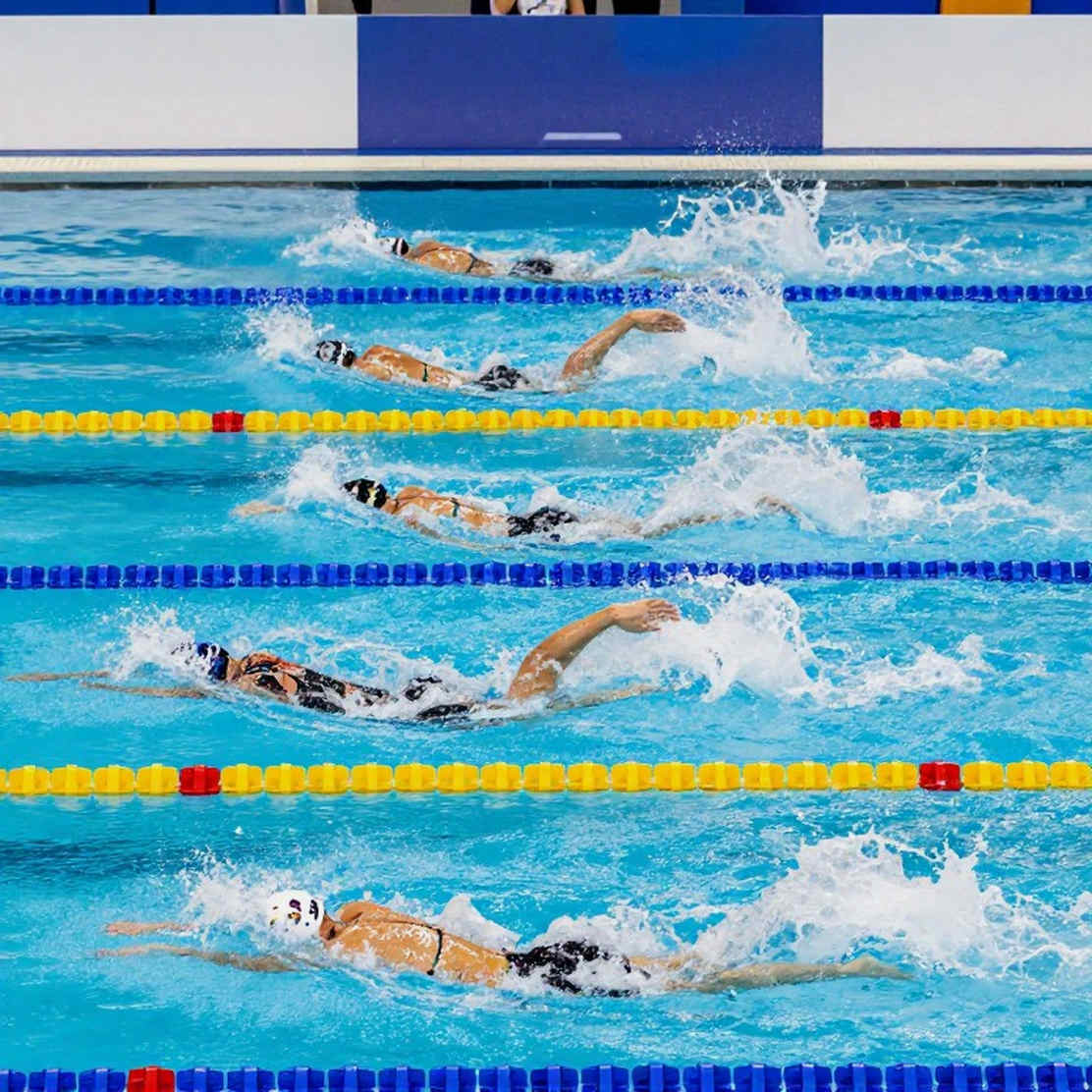
Match 3 featured four teams competing at one venue. Matches 1 and 2 were held at Westmont, on consecutive days. Two things can be inferred from that arrangement, and I am labelling them clearly as inferences, not announcements. One, two matches in one venue on consecutive days points to a travel-cost reduction plan. Two, four teams in one venue means a hybrid format sitting between a dual meet and an invitational, where team scoring rewards relays and depth more than a single star.
Let me also state my working method plainly, because readers deserve to know how I handle numbers. In 2026 I hand-timed Tokyo's universality heat swims frame by frame, because no Bangladeshi outlet was printing those splits. In 2026 I built the Qatar World Cup group-stage preview the same way — a fixed 40-column template, every column's definition written down, no exceptions. Tokyo and Qatar gave me splits that no editor wanted to print — so I became my own press.
This piece sits in the same discipline: four questions before every number — what is the denominator, what is the timeframe, who announced it, and what tier is the source. A number that cannot answer those four does not reach my table. I keep a public corrections log, where I retract wrong estimates and date the retraction, because numbers can be wrong, but hiding a wrong number is a failure of method.
Three matches, three numbers: 493, 714, 1,700-plus. Growth from the first to the second was 44.8 percent. Growth from the second to the third was about 138 percent, roughly 2.4 times. I plotted the curve in a spreadsheet — it is not linear, it is accelerating.
Experience says this shape appears in two kinds of events. Either demand is genuinely organising itself, or a star, a venue or the shine of novelty is lifting the number. Three points cannot separate the two. What they can separate is this — the three matches were not at the same venue, so they are not three steps of one series; they are three results from three different conditions. The 493 and 714 came from Westmont; the 1,700-plus came from Stanford. What a trend requires is consecutive points under the same conditions — and here the conditions changed.
Now the money. Let me be explicit: this is my arithmetic, not the league's announced revenue.
VIP: four suites × 19 seats = 76 seats × 100 dollars = 7,600 dollars. General admission: the remaining roughly 1,624 tickets × 25 dollars ≈ 40,600 dollars. Approximate total ≈ 48,000 dollars, with a range of roughly 42,500 to 48,200 dollars.
Estimated gate for the first two matches: 1,207 tickets, at the same price, in the region of 30,000 dollars. Match 3 alone is therefore about 1.5 to 1.6 times the combined gate of the first two matches. That ratio is the real number here, not 1,700 — because 1,700 is a point, and a ratio is a relationship.
Now my biggest question. A free dual meet does not force the host to keep gate accounting at all. The moment you sell tickets, costs appear — staffing, security, sound, broadcast, cleaning, ticketing-platform cuts, venue rental. Does an estimated 48,000 dollars cover those? I do not know, because the document contains no break-even data. A ticket count is an input; the business question is the output. I want to see a break-even line — the number above which the host profits, and below which the league books a loss.
There is another ceiling that few bother to write about. The venue holds 2,000. At 85 percent occupancy the league is already near its ceiling. Even at 100 percent, there are only two ways to raise revenue at this venue — a bigger venue, or a higher price. A model that stands inside a seat limit grows through price, not through volume. And raising the price takes nerve — and that nerve comes from durable demand, which is not yet proven.
The most reliable signal, to my eye, is not the 1,700 at all. The signal is that the suites sold out before match week. General admission demand inflates on novelty; the 100-dollar premium buyer is usually corporate or institutional, and decides early. That small but inelastic premium demand is more predictive than a general-admission spike. The 76-seat ceiling is very small; if the league expands its premium inventory for the next match, that will be a measure of its own confidence.
Venue brand versus league brand. Westmont gave 493 and 714; Stanford gave 1,700-plus. Which variable is the difference — the league's prestige or the venue's? Right now, attendance is being driven by the venue and programme brand, not the league brand. In American college football and basketball the rule is old — a big brand pulls its own crowd — and swimming is no exception. That means the league's expansion plan carries a hidden limit: at a non-elite host the number may fall, and if it falls, the headline will read that swimming cannot draw a crowd, when the truth will be that a venue without a brand cannot draw a crowd.
The geographic spread deserves attention too. Matches 1 and 2 were at Westmont in Illinois; Match 3 was at Stanford in California. A regional league usually rotates inside one state; Illinois to California suggests an ambition larger than regional. That is an inference, not an announcement — but a venue list is the most honest witness a league has.
The question nobody is asking sits in my table as an empty column. The governance of American college sport is the NCAA's amateurism framework. If a league takes gate revenue, sells broadcast, attracts sponsors, what do the athletes receive, and does that stay inside the amateur framework? The document does not answer it. A risk the document does not mention is not an absent risk; it is an unacknowledged one. When I see an empty cell, I write zero in it, never absent — because empty and non-existent are not the same thing.
Now back to Khulna. In Bangladesh, swimming is not a ticketing business; it is a game of state and institutional spending. Read the national medal table and an institutional picture appears — Navy first, Army second, BKSP third, the civilian clubs hollow. Nobody buys a ticket here; a swimmer is produced by an institution's budget line and disappears when that line is cut. So Stanford's 1,700 tickets are, to me, less a piece of swimming news than a question — how many ways can a sport pay for itself, and where there are no tickets, who pays?
This is where my second ledger comes in, the one I built in 2026. In March of that year my first salaried job — junior performance analyst at a Dhaka Premier Division football club, 32,000 taka a month — vanished the moment the league was cancelled. The stadiums stood empty. In that emptied season I digitised five years of newspaper drowning reports: 1,180 child drowning incidents from 2026 to 2026, cross-mapped against upazila flood calendars and pond density. The Khulna Division cluster emerged as the tightest in the country. A CIPRB-linked prevention programme used that map in a 2026 briefing.
The empty season taught me that absence is still a dataset. In my ledger every row must carry four mandatory fields — district, upazila, month, water-body type. An unfilled row is an incomplete row, and no decision can rest on an incomplete row. In reporting where there is no name, no district, no month, a child dissolves into a percentage. I do not allow that — which is why in this piece I wrote the discipline of district, month and water body first, and Stanford's gate revenue second.
By the same principle I keep a hand-written record of English Channel crossings. Brojen Das trained in the Buriganga before crossing the Channel, then Abdul Malek, then Mosharraf Hossain — and then a thirty-seven-year silence until the 2026 relay. I do not wave that gap away as empty space; thirty-seven years is not an accident, it is an administrative KPI — which year had no budget, which year sent no swimmer, that accounting is written inside the gap. Where attendance is a dataset, absence is a larger one.
Now the biggest doubt of all, because one column I always leave open — the column for doubt. Every model needs a witness.
The 1,700-plus figure was announced on a broadcast. It is not an audited gate count. An announced number at a live event is a promotional number, and mild inflation there is normal. I am not rejecting the figure; I am labelling its tier. A promotional number and an audited number cannot sit in the same cell, just as an estimated revenue and an accounted revenue are not the same thing.
My second doubt: is the spike at Stanford a spike in swimming demand, or a spike in Stanford's brand? Stanford is a famous name, and a famous programme carries its own crowd. Attendance and cause are not the same thing; when two numbers rise together, many assume cause, when the rise is mere co-movement. Co-movement is not proof — it is a hypothesis, to be tested at the next match.
My third doubt points at myself, and I do not hide it. I know my own template rigidity: once I have defended a metric in public, I am slow to drop it. A long-distance river race and an indoor college match cannot be forced into the same 40-column mould — the mould should follow the water. In this piece I deliberately set the mould aside: there are no stroke-split columns here, only ticket, price, seat and venue columns. A template is a quality-control instrument, and rigour does not mean one template everywhere — rigour means the right template each time.
My fourth doubt points at the transfer market. This is transfer-window season, and the rumour is everywhere. A transfer window is just a deadline with better rumours — and an attendance milestone is the same kind of headline, where the denominators matter more than the banner. In coverage that now talks only about 1,700, the denominators are 2,000 seats, 493, 714, and an unknown cost line. Small sample, smaller claim — that principle hangs on my wall.
I leave you with a forecast.

On the next step I will watch three triggers. One, where Match 4 is held — if it is at a non-elite host and clears 1,200 tickets, demand can be treated as repeatable; another 1,700 at Stanford proves nothing, because it repeats the same test. Two, whether premium inventory is expanded beyond 76 seats — if it grows, the league is betting on its own premium demand. Three, whether the NCAA position is clarified — whether the league sits inside or outside the amateur framework.
For Bangladesh my tracking line is different. Here swimming will be kept alive not by tickets but by budget lines — which ministry line, how much money, which district, how many ponds, which month, how many children. So from Khulna I will not watch Stanford's gate revenue; I will watch our own pond numbers — how many children a day, which district, which month, which water body. A 100-dollar suite at an American college and a village pond in an upazila — if the question is who keeps swimming alive and who does not, they are two ends of the same ledger. And nobody can write swimming's future without holding that ledger in hand.